The Slow Vanity Leak That Took Out a Hallway
A homeowner on the north side of Woodcreek Reserve called us on a Tuesday morning. She had pulled out a stack of towels from under her master bath vanity and found them soaked through. The shutoff valve on the hot side had been weeping for what we estimated was three to four weeks based on the staining on the cabinet floor. By the time we arrived with moisture meters, the reading on the hallway hardwood twenty feet away was 28 percent. Wood flooring is generally considered dry at 12 percent or below.
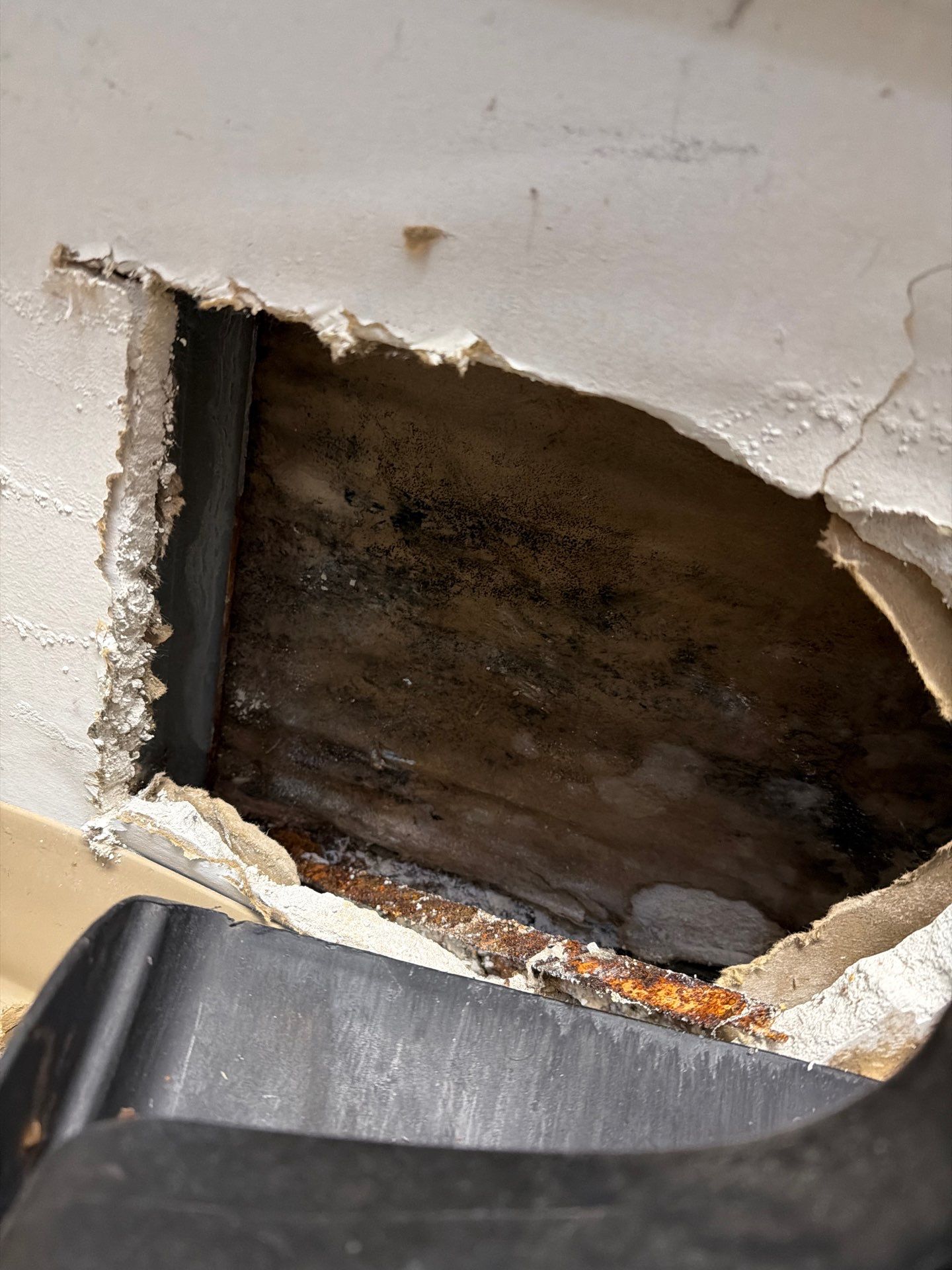
We pulled the vanity, cut a relief hole in the back of the cabinet, and ran our thermal camera along the adjacent wall. The drywall behind the cabinet was Category 2 water, which the IICRC classifies as grey water because of the contamination picked up from cabinet particle board and the long dwell time. That changed the scope. Instead of drying the drywall in place, we did a controlled flood cut at 24 inches, removed the wet insulation, and set six air movers and a dehumidifier rated for 130 pints per day. The hallway floor came down to 14 percent in 72 hours. Two boards near the threshold cupped permanently and had to be replaced, but the rest of the hardwood was saved. Total mitigation invoice ran about $3,400. Insurance covered it after a $1,000 deductible.
The detail that made this job recoverable rather than catastrophic was the baseboard. Because the original installer had left a small expansion gap behind the quarter round, moisture had a vent path and did not pressurize into the wall stud bay as quickly as it could have. We see the opposite scenario constantly, where caulked baseboards trap water against drywall paper and turn a 36 hour discovery into a full tear out. Small construction choices made years before the leak end up dictating how much demolition we have to do.
The Slab Leak Nobody Saw Coming
One Woodcreek Reserve family called at 9pm on a Sunday. Their utility bill had jumped 60 dollars that month and they could hear a faint trickle when the house was quiet. We ran a thermal scan across the slab and found a six foot hot spot running diagonally from the laundry room into the dining area. A copper supply line under the slab had failed at a solder joint. By the time we arrived, the engineered hardwood in the dining room had absorbed enough moisture to delaminate.
This is one of the harder conversations we have. We told the homeowner directly: the flooring in the affected area is not salvageable, and the plumber will need to either reroute the line through the attic or jackhammer the slab. We coordinated with their plumbing contractor, set containment with plastic sheeting, and ran dehumidifiers for five days while the repair was completed. We documented every reading for the insurance adjuster, including before and after photos, moisture maps, and atmospheric readings. The claim paid out roughly $11,200 for mitigation and flooring replacement combined. If you want the deeper background on this kind of stealth leak, our notes on water damage behind walls and hidden leak detection walk through the diagnostic process step by step.
What These Stories Have in Common
Across hundreds of plumbing leak calls in Woodcreek Reserve, the same five factors decide whether you are looking at a $2,000 job or a $15,000 job:
- How long the water sat before discovery (under 48 hours is a different category than two weeks)
- Whether the water reached subfloor, joists, or wall cavities
- The flooring type and whether it can be dried in place
- Whether mold had time to colonize, generally 48 to 72 hours in warm conditions
- How quickly mitigation equipment was deployed and monitored
The homeowner who calls us within hours almost always pays less and keeps more of their original materials. The homeowner who waits a week because they thought they could handle it with shop towels and a box fan ends up paying for demolition that could have been avoided. We have walked into Woodcreek Reserve homes where a $400 same day extraction would have prevented a $9,000 reconstruction. That is not a sales pitch, it is just what the moisture readings tell us.
How We Document Everything for Your Claim
One Greenwood homeowner asked us why we take so many photos. The answer is that insurance adjusters work from documentation. Every plumbing leak job at Woodcreek Reserve Water Restoration includes moisture mapping at intake, daily psychrometric readings, photo documentation of demolition scope, equipment placement logs, and a final clearance reading. We submit that package directly to your adjuster, which usually shortens the claim timeline by a week or more. Our IICRC certification and BBB A+ rating give that paperwork weight when there is a coverage question.
We have also learned to photograph the source of the leak before the plumber repairs it, because adjusters occasionally deny claims that lack a clear origin photo. A two minute pause to document a cracked fitting has saved Woodcreek Reserve homeowners thousands in disputed coverage.
The Drain Line That Looked Like a Small Problem
A Woodcreek Reserve homeowner came home from work and found a one foot wet ring around the base of his toilet. He shut the supply valve, mopped it up, and figured the wax ring had failed. He called us three days later because the ceiling in the basement below had started to bubble. When we cut an inspection hole, we found that the leak was not from the wax ring but from a cracked closet flange that had been weeping every flush for weeks. The subfloor under the toilet was rotted through to the joist.
That job involved removing the toilet, cutting back roughly 14 square feet of subfloor, treating the joists with antimicrobial, and coordinating with a plumber to replace the flange. The basement ceiling drywall came down in two sections. We dried the cavity for four days. Hidden plumbing leaks like this are why we always recommend reading our walkthrough on wet drywall repair and restoration before you start cutting things yourself.
The homeowner asked a fair question while we were packing up: how could he have caught this sooner? The honest answer is that drain leaks only show themselves when something is running through the line, which is why the wax ring theory is so common. A simple test we walk people through now is to place a dry paper towel around the base of the toilet flange after a flush and check it ten minutes later. If it picks up any color, the seal is failing. It is a thirty second check that could have saved this homeowner roughly $6,000.